Crochet, knitting, astronomy & life in general.

Showing posts with label astronomy. Show all posts

Thursday, December 4, 2014

SPIDER: A balloon-borne telescope

At this very moment, a team of astronomers is braving the Antarctic summer weather (which is just as bad, if not worse, as winter here in Toronto) for SCIENCE! The experiment called SPIDER (which I mentioned in a previous post) is a balloon-borne telescope designed to measure the polarization of the Cosmic Microwave Background (CMB), the light left over from the Big Bang. It will be launched later this month to commence a 20-day journey around the Antarctic continent in order to collect light from the CMB and to try to look for the pattern of ripples in space-time produced from the Big Bang itself.


Photo courtesy Jon Gudmundsson

Among these intrepid scientists are a few of my colleagues from the University of Toronto. My friend Jamil is taking some gorgeous photos of SPIDER's assembly, as well as of the breathtaking Antarctic landscape. He was also interviewed on the CBC's Metro Morning and gave a wonderful explanation of what the project is all about. It's well worth a listen.

Finally, if you want to learn more about this really cool project, you should check out the SPIDER blog, set up by the Princeton contingent of the team. There you'll see how the telescope is being assembled, and get a unique snapshot into the lives of people currently living in Antarctica.

Wednesday, October 8, 2014

So do black holes exist or not?

The internet has been all aflutter this past couple of weeks with the news that black holes have supposedly been mathematically proven not to exist. The trouble all started earlier this year when Stephen Hawking declared that the existence of an event horizon, the region around a black hole past which even light cannot escape, is incompatible with quantum mechanics. (You can read the original paper here if you feel you can handle the jargon.) Now, physicist Laura Mersini-Houghton, in a recent paper (not yet peer-reviewed) is claiming that black holes would not be able to form when dying stars collapse, which is the primary mechanism astronomers use to explain the existence of stellar mass black holes (those that are a few times more massive than the sun).


By Oliver Krause (Steward Observatory) George H. Rieke (Steward Observatory) Stephan M. Birkmann (Max-Planck-Institut fur Astronomie) Emeric Le Floc'h (Steward Observatory) Karl D. Gordon (Steward Observatory) Eiichi Egami (Steward Observatory) John Bieging (Steward Observatory) John P. Hughes (Rutgers University) Erick Young (Steward Observatory) Joannah L. Hinz (Steward Observatory) Sascha P. Quanz (Max-Planck-Institut fur Astronomie) Dean C. Hines (Space Science Institute) [Public domain], via Wikimedia Commons

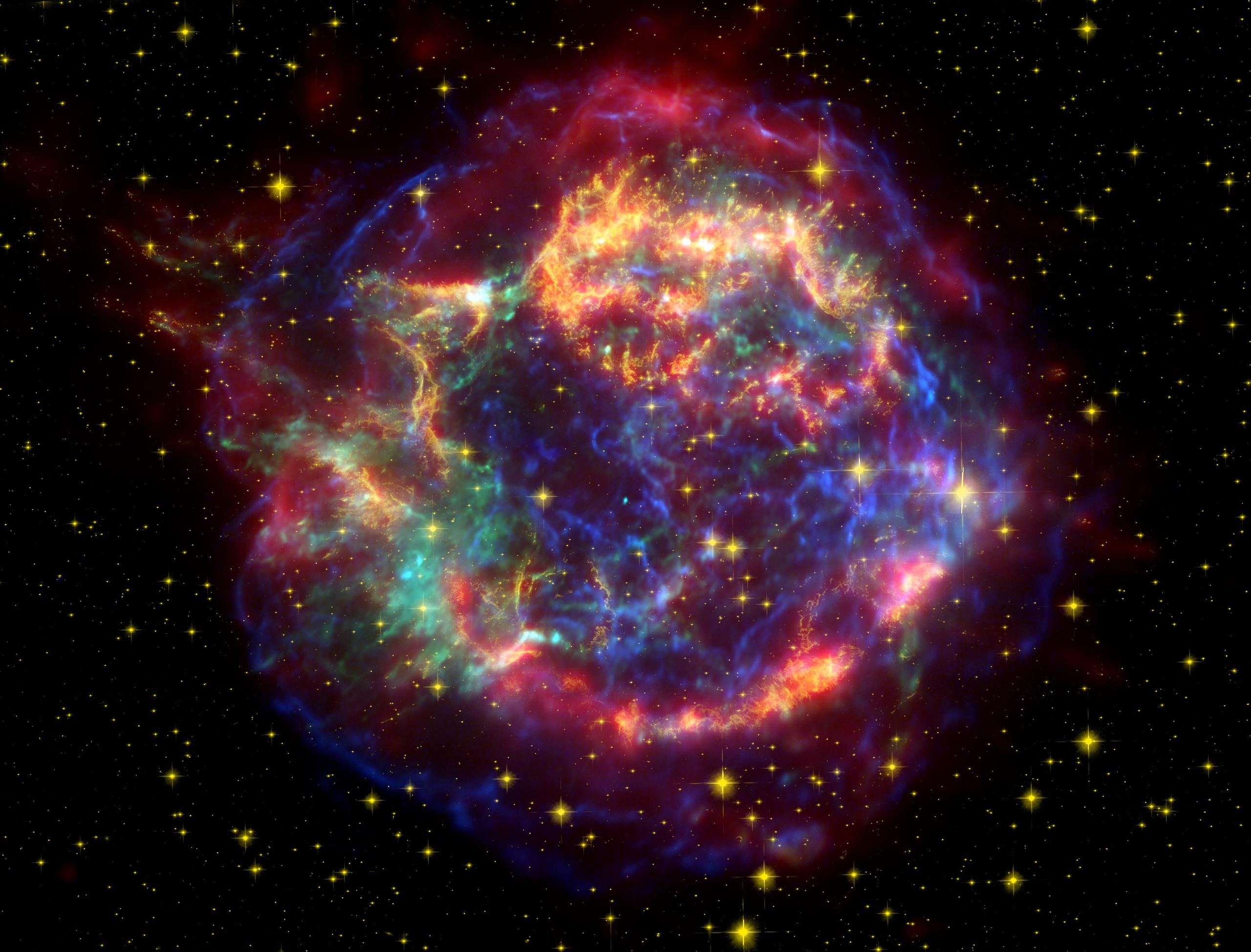
Our current theory of stellar mass black hole formation is that these objects are created when a star goes supernova due to the collapse of its core. When a star is about 8 times more massive than our Sun, it is able to fuse heavier and heavier elements, working its way along the periodic table, until it starts producing iron. The problem with iron fusion is that it's an endothermic reaction, taking in energy, instead of an exothermic reaction, giving off energy, such as when the fusion of lighter elements occurs. Thus, the outward pressure coming from fusion reactions that would counteract gravitational collapse is no longer present. When enough iron builds up in the core, it collapses in on itself either into a neutron star, or, if the original star was at least 20 times as massive as the sun, a black hole. The outer layers of the star would then collapse inward as well, having nowhere to go, and reach a critical temperature which would cause them to explode outward as an extremely energetic supernova. (PhD Comics made a nice video explaining this.) The image you see above is of Cassiopeia A, the remnant of a supernova which was thought to produce a black hole.

The basic idea of this new paper comes from Stephen Hawking's calculation in the 1970s that showed that black holes should emit thermal radiation (called hawking radiation). Essentially, quantum fluctuations in a vacuum might sometimes produce a pair of particles. If this happens near the event horizon of a black hole, due to the gravitational energy of the singularity, one of the particles will fall in, and the other will escape, causing the black hole to lose energy, and therefore mass. Mersini-Houghton claims that the amount of hawking radiation produced during the collapse of a massive star's core is so much that the black hole would never be able to form. Essentially, the black hole would evaporate away before it got a chance to come into being, and this would mean that stellar mass black holes can't form.

Bob Novella of the Skeptic's Guide to the Universe does a pretty good job of deconstructing why this research might not make that much sense in reality (see part 1, and part 2). The first, most obvious counter-argument is that we do, in fact, observe evidence of stellar mass black holes in our galaxy. Many of these are in what we call X-ray compact binary systems, where a black hole is in a binary system with a star from which it is cannibalizing material. The material falling in towards the black hole releases so much energy that it is seen to radiate in the X-ray spectrum of light. The second argument is that many physicists who specialize in black holes are skeptical (to put it mildly) about the results of this paper, including Bill Unruh who has proclaimed that this paper is "nonsense".

Now, I will admit that I have a small personal investment in this topic in that my thesis supervisor, Harald Pfeiffer, is the second author on Mersini-Houghton's paper. He is an expert numerical relativist and I have no doubt that his numerics are sound. The problem is most likely the assumptions made prior to any numerical simulation. At any rate, the topic of my doctoral thesis (which I might write about someday) depends on the existence of stellar mass black holes, so I certainly hope that they're wrong in this case!

One final point I'd like to make is that although this paper claims that the mechanism for producing stellar mass black holes would not work, it says nothing about the formation of other types of black holes, that is, supermassive and intermediate-mass black holes. Both of these have been found to exist, the former in the core of almost every galaxy, and the latter at the centre of globular clusters. In particular, there is ample evidence that supermassive black holes exist, especially from the observation of the movement of stars at the centre of our own galaxy. It's exceedingly irresponsible for popular science articles to claim that this research shows that any type of black hole can't exist. And so, the short answer to the question posed in the title of this post: "Yes, they probably do."

Friday, August 29, 2014

Gaia and the Cosmic Distance Ladder

I first heard about Gaia (Global Astrometric Interferometer for Astrophysics) during my undergraduate studies around 8 years ago. Although the impending space mission was hailed as one of the most important of the 21st century, it seems like it hasn't received nearly enough press in the last little while, which is why I wanted to talk about it in this blog post. The Gaia spacecraft was first proposed in 1993, on the coat tails of the Hipparcos mission, and was finally launched in December of 2013. And, as of a European Space Agency press release on July 29th, Gaia is now ready to do science!


Credit: "Gaia spacecraft". Via Wikipedia.

Gaia's motives range from discovering extra-solar planets to detecting quasars, but its most important purpose, in my opinion, is to precisely measure the distance to over 200 million stars within our galaxy to an accuracy of 10%, and out to a distance of 30,000 light years, well beyond the Milky Way's galactic centre. These distance measurements are obtained through a process called stellar parallax, where the apparent motion of a star is observed compared to more distant background stars as the Earth moves around the Sun.


Credit: "Stellarparallax2" by Original uploader was Booyabazooka at en.wikipedia - Originally from en.wikipedia; description page is/was here.. Licensed under Public domain via Wikimedia Commons.

Not only will the precise determination of the distance to this many stars in the Milky Way provide us with a detailed representation of the structure of our galaxy, but parallax is the most important fundamental measurement in the cosmic distance ladder. The cosmic distance ladder (or CDL) is a series of methods for determining distances in the cosmos which are calibrated to each other to greater and greater distances. The first rung in the CDL is the distances within our own solar system, which have been determined to great accuracy with radar. Once the Earth-Sun distance is determined precisely, accurate parallax measurements can be made.


The next rung on the CDL is a class of objects called a Standard Candles. These are objects which have a known brightness, and therefore, when their apparent brightness is observed, one can calculate how far they are (sort of like figuring out the distance of a car based on how bright its headlights look). A couple of famous examples of standard candles are Cepheid Variables and Type Ia Supernovae, which are used to calculate the distance to objects much further than can be achieved with parallax (such as with distant galaxies). However, in order to calibrate the intrinsic brightness of these objects, the distance to nearby standard candles must be computed via some fundamental measurement, such as parallax. Thus, having accurate parallax measurements for nearby objects allows astronomers to determine the distance to bodies which are much further away.

It becomes apparent, when the determination of distance to far-away objects must be calibrated in this way, that an error in a lower rung of the CDL can seriously affect the distance measurements to very faraway galaxies. This problem became clear in the early 20th-century when Edwin Hubble was making his first distance measurements to nearby galaxies. When he discovered that the Universe is expanding, he calculated the age of the Universe to be only about 2 billion years, which was a problem because the age of the Earth had been estimated to be at least 3 or 4 billion years! This was later resolved when the brightness of Cepheid Variables was properly calibrated, which more than doubled the calculated age of the Universe. We now know the age of the Universe to be 13.8 billion years, and the value is mostly obtained from the distance measurements of far-off galaxies.

In conclusion, accurate distance measurements to objects within our own galaxy can have implications for our understanding of the history of the Universe! Even though the primary purpose of Gaia is to map out the structure of our galaxy, it will have a great impact on our knowledge of cosmology.

Wednesday, March 19, 2014

Ripples in Space-time from the Beginning of the Universe

The big news all over my Facebook feed (because obviously that's how I get news) Monday morning was all about what might possibly be one of the biggest discoveries about the Big Bang since the Cosmic Microwave Background (CMB), the faint glow of light left over from the Big Bang, was inadvertently discovered by Penzias and Wilson in 1964. The Southern Pole microwave telescope BICEP2, which stands for Background Imaging of Cosmic Extragalactic Polarization 2, measured a small signal in the CMB providing the first evidence for Cosmic Inflation.


Image Credit: BICEP2 Collaboration, NSF, Steffen Richter (Harvard)

Inflation was a theory first introduced by Alan Guth in 1980 that was designed to explain why the Universe appeared so uniform in all directions. Without Inflation, because widely-separated regions would have been moving away from each other faster than the speed of light, and so were not yet in causal contact, the Universe would not have had enough time to reach the temperature equilibrium we see evidence of in the CMB today. The solution was to have a period of rapid expansion in the first few fractions of a second after the Big Bang. Thus, a small region of space which was able to reach an equilibrium expanded extremely quickly to become an enormous volume that wasn't causally connected anymore, but that had achieved uniformity. The slight differences in temperature which we observe in the CMB would therefore have originated as quantum fluctuations magnified by the inflationary process.


Image Credit: BICEP2 Collaboration, NSF

Although Inflation solves the problem of the uniformity of the Universe, until recently it had no observational evidence to back it up. BICEP2 was able to provide this evidence in the form of tiny twisting fluctuations in the polarization of the CMB, that is, the preference of light to vibrate in one direction over the other, called B-Modes (see the top-right corner of the first image in this post). This polarization signal, which appear as faint spiral patterns on the CMB, is a result of ripples in space-time, called gravitational waves, created in the earliest moments of the Universe. Gravitational waves cause space itself to get squeezed and pulled apart very slightly, and this would manifest itself by twisting the polarization of the light coming from the Big Bang.

With an amazing discovery like this, it's tempting to make grand proclamations about how we now know how the Universe began, but unfortunately, we still don't understand the mechanism which caused Inflation. On top of this, only one team has made measurements of these B-Modes in the CMB, and it is wise to wait for confirmation from other experiments before getting too excited. One such experiment is called Spider, a balloon-borne experiment lead by Barth Netterfield at the University of Toronto in collaboration with teams from Caltech, Princeton, Stanford, and others. It was meant to fly this past December in Antarctica and make its own measurements of the CMB polarization, but because of issues at NASA, the experiment is delayed until next winter. Hopefully, it will then be able to confirm the results obtained by BICEP2.


Image Credit: Spider Collaboration, B.P. Crill et al.

You can learn more about this recent discovery by checking out these articles by the New York Times (with an excellent infographic about Inflation), Scientific American, and Space Ref, or by reading the original release from the BICEP2 team.

Wednesday, October 17, 2012

55 Cancri in the Skies with Diamonds

I was recently considered as an interviewee for Radio-Canada (I knew being fluent in French would pay off someday!) to be the "expert" about a recently characterized "diamond planet". I did a lot of research on this new discovery, but I didn't end up doing the interview. Since I hate letting good research go to waste, I thought I'd talk about it here!


Artist's concept of 55 Cancri e - Credit: NASA/REUTERS

This extra-solar planet was first discovered in 2004 (by McArthur et al.) orbiting around the star 55 Cancri A, a sun-like star about 40 light years away in the constellation Cancer. It has the designation "A" because it is in a wide binary system with a much smaller red dwarf companion. McArthur and company discovered the planet by the radial velocity method, that is, by looking at the Doppler shift of 55 Cancri A due to the wobble caused by the gravitational pull of 55 Cancri e. Sort of like this:


Image stolen from Wikipedia

The radial velocity measurement gave astronomers an approximate mass for this planet, and also the orbital period, but it wasn't until recently, when, in 2011, 55 Cancri e was observed transiting its host star (by Winn et al.), that we were able to determine how large this planet is. The transit measurements, by the way, were taken with the MOST satellite, which is the only Canadian Space Telescope. It looks kind of like a suitcase:


Image stolen from UBC's MOST website

Anyway, based on the transit and radial velocity data, it was determined that 55 Cancri e is eight times as massive as the Earth, and its radius is twice that of the Earth's. That would give it a surface gravity about twice as large as on Earth. In addition, its orbital period (or year) is only 18 hours long, which would give it a surface temperature of over 2000 degrees Celsius! We shouldn't go around calling this a second Earth any time soon... it's hot and heavy over there!

The most recent development, which made the news last week, is that astronomers (Madhusudhan et al.) now think that this planet might be made primarily out of carbon. That would mean that it would have an iron core, a layer of diamond (which might be 3 times as massive as the Earth), and a molten graphite surface. Previously, it was hypothesized that 55 Cancri e might have a rocky core like the Earth's surrounded by a layer of super-heated water. That assumes, of course, that it's made of the same sort of rocky stuff as in our own solar system which is primarily oxygen-based.


The plot above shows the radius versus mass of several extra-solar planets, including 55 Cancri e as the red and blue dots (these represent two different measurements). The different curves represent various models based on the composition of the planet, and a primarily carbon-based planet seems to make sense in this case. It helps that the host star appears to have more carbon than our own sun, and that a superheated water layer would be extremely volatile. More measurements, of course, will help determine the exact composition of the planet.

This is the first extra-solar planet that is thought to be made of diamond (unless you count that "diamond planet" I talked about last year), and if 55 Cancri e turns out to be carbon-based, it would revolutionize how we think of planet composition. We usually think of planets being composed of mostly the same stuff as in our own solar system, but there's no reason why some planetary systems couldn't be made up of slightly different stuff!

Friday, February 24, 2012

Einstein is still ok


Remember back in September when I wrote about faster-than-light neutrinos? Scientists at CERN running the OPERA experiment had claimed to record neutrinos arriving at a detector 60 nanoseconds faster than they would have if they had been travelling at the speed of light. There has been a ton of skepticism around this result, and now, it turns out, the discrepancy in the arrival time is probably due to a faulty connection between the GPS unit and the computer.

Anyway, the team will have to rerun the experiment to make sure that this is indeed the source of that error, but it looks like Einstein's Theory of Relativity is still valid. Nothing can travel faster than the speed of light. If you want to read more about this, check out this Wired article, this Science Insider article, or this Telegraph article.

Friday, October 21, 2011

Crashing Comets into the Sun

Here's a neat little tidbit: a video off NASA's Astronomy Picture of the Day (APOD) showing a comet crashing into the Sun (or at least approaching it very closely and probably disintegrating) and the coronal mass ejection that follows...


Now, these two events are likely unrelated because comets are so small compared to the sun that they shouldn't have any effect on solar activity, so it's likely just a coincidence that these events occurred together. As Phil Plait from Bad Astronomy explains, the Sun is fairly active right now, with these coronal mass ejections happening all the time. It's also fairly common to see this special class of comets called "sungrazers" go very close to the Sun, sometimes crashing into it. So, if you have two events that are fairly common, chances are that eventually they'll happen at the same time.

Oh, and in case you were thinking that maybe we've finally seen real evidence of alien life, that flying saucer thing in the background is actually the planet Mercury... so no need to worry. You can read more about this event on the SOHO (SOlar and Heliospheric Observatory) website or on the Sungrazing Comets blog.

Wednesday, October 12, 2011

Astronomy Wednesday: Weather on failed stars

I'm constantly amazed by the awesome things my colleagues are doing. It just goes to show that even graduate students can make really neat cutting edge discoveries in Astrophysics. The most recent star (haha... no pun intended) in our department is Jackie Radigan, a 5th-year PhD student working with Ray Jayawardhana. She studies weather on brown dwarfs, which are essentially failed stars, and has recently made some interesting discoveries, which you can read about here and here.


Artist rendering by Jon Lomberg

Brown dwarfs are astronomical objects that bridge the gap between massive gas giants, such as Jupiter, and the smallest stars. They range from about 13 to 80 times the mass of Jupiter, and though they form in the same way as regular stars, where big clouds of gas collapse under the force of gravity into spheres, they are too small to fuse hydrogen into helium. When they first form, they can be almost as bright as real stars, but as they age, the heat from their formation dissipates and they become fainter and fainter. Because brown dwarfs are so faint, they're extremely difficult to detect and so the first one was only discovered in 1988. If you want to learn more, you can look into basic or advanced online astronomy classes.


Image of Las Campanas Observatory stolen from Wikipedia

Several of these objects have been discovered since, using large all-sky surveys that explore light in the near-infrared such as 2MASS. Jackie herself has been using the DuPont 2.5-m telescope located at Las Campanas Observatory in the Atacama desert in Chile (pictured above). I'm a little bit envious that she gets to travel to this gorgeous location (since the furthest I've ever been sent on the school's dime is to Milwaukee for a conference... I should write about that sometime). Turns out that that this observatory is also where University of Toronto prof. Ian Shelton made the discovery of the famous Supernova 1987A. That's an interesting connection.


Image of Jupiter's surface stolen from NASA

Anyway, as she tells it, Jackie was sitting in the airport on her way to Chile when she got an email from one of her collaborators with a plot showing a 30% change in brightness over 8 hours of the brown dwarf 2MASS 2139, which is approximately 47 light-years away. This variation is about 10 times larger than one would expect from magnetic features such as sunspots. She and her collaborators think that this change is due to a huge storm on the surface of the brown dwarf that blocks out some of the light coming from the brown dwarf's surface, something like a supercharged version of Jupiter's Great Red Spot (pictured above). The change in brightness comes about as the brown dwarf rotates on its own axis. With more detailed observations, that is, with higher resolution and a broader frequency range, they'll be able to make sure that their model is correct.

It will be very interesting to see what sort of follow-up results Jackie and her collaborators come up with over the next several months. A paper about this research will be submitted to the Astrophysical Journal very soon, but you can read her preliminary article here.

Friday, September 30, 2011

Astronomy Friday: Faster than Light Neutrinos?


The big thing in Physics news lately has been the results from the OPERA experiment which showed that these sub-atomic particles called neutrinos were travelling slightly faster than photons, the massless particles that light is made of, would have. This result is especially interesting because according to Einstein's theory of Relativity, nothing is supposed to be able to travel faster than the speed of light. You can read about these results all over the internet (here and here, for example), but the basic idea is that scientists at CERN shot some very high-energy neutrinos through the Alps and into a detector, which measures how long it took them to get there. What was found was that the neutrinos reached the detector 60 nanoseconds faster than they would have if they were traveling at the speed of light.

It might be useful to talk a bit about what neutrinos actually are. These weakly-interacting, neutral elementary particles were first proposed to exist by Wolfgang Pauli in the 1930s to help conserve energy and momentum in a process called beta decay, but weren't detected until 1956 in an experiment using beta-capture, where an anti-neutrino and proton combine to make a neutron and positron. Nowadays, we routinely detect neutrinos coming from the sun and from distant supernova explosions. This little particle was central to a scientific conundrum called the "Solar Neutrino Problem" where only about a third of the number of neutrinos expected to be coming from the sun were detected. This was solved by the discovery that neutrinos have mass (though a very small one), and come in three different types which they can oscillate between at random.


The layout of the OPERA experiment.

Since neutrinos are supposed to have mass, the results from the OPERA experiment are mildly disturbing. Relativity is founded on the principle that objects with mass cannot travel at the speed of light, much less faster than it, and if neutrinos can, in fact, travel faster than the speed of light, then we would have to seriously change all our ideas about spacetime and gravity. Fortunately, this is a very preliminary result, and there is a good chance that it's wrong. Not that the scientists performing the experiment were bad at their job or anything, but there are many sources of error that might pop up. As someone once said, "Extraordinary claims require extraordinary evidence." That means that physicists probably aren't going to take these results seriously until another experiment can verify them.

I'll certainly be keeping an eye on it... already there are a flurry of papers on the arXiv attempting to explain the OPERA results. If you want to read the original paper, check it out here.

Monday, September 5, 2011

Astronomy Monday: Diamonds in the Sky

Happy Labour Day, everyone! I thought I'd start off the week with some cool science because it's been a while since I've rambled on about astronomy here...

A couple of weeks ago, scientists announced that they had discovered a new millisecond pulsar with what is most likely the degenerate core of a star orbiting it. Since this newly discovered planet-like object probably has a mass close to Jupiter's but a radius closer to that of the Earth, it is extremely dense, and since it is most likely composed primarily of carbon, it would have a crystalline structure. In the media, of course, this is being announced with the sensational headline "Diamond planet found!"


The pulsar around which this planet is orbiting is called PSR J1719-1438, and it is a neutron star with a rotational period of 5.7 milliseconds. It's located in the constellation Serpens and is 4000 light years from us. A neutron star, of course, is the compact object that remains after a massive star goes supernova. As you might have guessed from their name, neutron stars are composed almost entirely of neutrons since the gravitational force of these objects have on themselves is stronger than the force keeping electrons and protons as separate particles (also called electron degeneracy pressure).

Neutron stars are often called "pulsars" because they emit regular bursts of light in the radio part of the spectrum. Since neutron stars used to be very large objects and were compressed into a small volume, they spin very quickly (hence "millisecond" pulsar) and have extremely large magnetic fields. Like supercharged northern lights, charged particles would be drawn in by the magnetic field and emit light as they speed up towards the magnetic poles (though this happens because of the interaction of these charged particles with our atmosphere on Earth). Just like with the Earth, the magnetic poles and axis of rotation aren't lined up, so as the neutron star rotates, the flash of light caused by these accelerating charged particles twirls around like a lighthouse. This is best shown in a diagram (stolen from the ATNF Pulsar Education page):


The interesting part about the PSR J1719-1438 system is that the "planet", which is called PSR J1719-1438b, is in fact believed to be the core of a dead star, which is certainly not how we usually think about planets being formed. Planets like those in our solar system were formed about the same time as the sun. The big cloud of gas out of which our sun was formed collapsed into a disk, and out of this disk gradually clumped together what would become the planets in our solar system. It would have looked something like this (from Astronomy Online):


What scientists think happened in this case, however, is that the PSR J1719-1438 system was originally a binary star system with one star large enough to go supernova and the other less massive. Because it would have burned through it's fuel more quickly, the more massive star would have died first and gone supernova, turning into the neutron star. The smaller star would have burned through its stellar fuel more slowly and as it started to turn into a red giant, its outer layers expanding as it finished burning hydrogen into helium and progressed to burning helium into carbon, the neutron star would start stripping material off its companion. The outer layers of hydrogen and helium would be torn away leaving only the dense core of carbon. In a slightly different situation, the smaller star might have been completely destroyed by the neutron star, but in this case, the tiny core was just far away enough (at 600,000 km, roughly the distance between the Earth and the Moon) and compact enough that it was able to survive.


Though this is a very exciting discovery, I have some, probably unfounded, issues with calling this object a planet. The official IAU definition of a planet is as follows:
"A "planet" is a celestial body that: (a) is in orbit around the Sun, (b) has sufficient mass for its self-gravity to overcome rigid body forces so that it assumes a hydrostatic equilibrium (nearly round) shape, and (c) has cleared the neighbourhood around its orbit.
Though all these criteria are probably true for PSR J1719-1438b, it seems strange to call something a planet which used to be a star.

At any rate, this is very cool science and I'm looking forward to seeing if more systems like this are discovered!

Tuesday, June 28, 2011

Astronomy Tuesday: Living in a Hologram

It's been a while since I've written about astronomy, so I figured I should get back on it. I just got back from a public lecture given by Leonard Susskind of Stanford University which was this year's Sackler Public Lecture hosted by the Canadian Institute for Theoretical Astrophysics (CITA). Susskind is one of the great living physicists, and is certainly one of the best public lecturers I have ever seen. He has a Feynman-esque quality to his talking, and it's not just the New York accent. The ideas he presented flowed beautifully into one another, and though all his diagrams were obviously created in MS Paint, I never once felt like I was missing the point.

His lecture this evening was about the Holographic Universe, which doesn't have anything to do with holograms like in Star Trek, but instead means that all the 3-dimensional information in the universe can be represented on a 2-dimensional surface, sort of like how the 2D surface of a hologram shows 3D features. (Image from Crispers Handmade Holographic Images page)


The story began with black holes, which are one of my favourite things to talk about (and are, in fact, the area of my research, which I might talk about someday). These objects are essentially points of infinite density that have an imaginary boundary called the "event horizon" which is the point beyond which even light cannot escape the gravitational field of the black hole. That is, you'd need to be traveling faster than the speed of light in order to escape its gravitational pull. Susskind used a nice analogy with fish and a whirlpool in a lake, where past the event horizon, it is impossible for the fish to swim fast enough to escape the whirlpool. The following diagram (taken from AnsweringGenenis.com, which is a pretty good article if you ignore the God stuff) shows the basic idea:


It got a little more complicated after that. One of the most fundamental laws of physics, he says, is that information cannot be lost to the Universe. Even when you delete a little piece of information off your hard drive, for example, that information is transformed into heat which goes out into the environment. The problem with this, however, is that when something falls into a black hole, all information about that object is lost to the outside world, since even the light from that object can't escape the black hole's event horizon.

The next issue has to do with entropy. Entropy is a quantity which more or less describes the amount of disorder in a system. In thermodynamics, it's officially defined as the "unavailability of a system's thermal energy for conversion into mechanical work" (Google Dictionary). A commonly-used example is gas in a box. If you have one side of a box that has a bunch of gas molecules in it, and the other side is a vacuum, and you remove the barrier, the gas will go from one side of the box to the other and eventually mix more or less evenly. (Diagram from Principia Cybernetica Net)


The idea is that it goes from a state of higher order, with the gas molecules on one side of the box, to a state of less order, with the gas molecules floating all around the box. With a black hole, however, you'd expect the disorder to decrease if some gas fell in past the event horizon because the gas would become part of the black hole, which can be described simply by the size of its event horizon. However, a very smart guy named Jacob Bekenstein used some fancy physics to show that black holes actually have very high entropy, and that it can, in fact, be explained by the following elegant formula:


I'm not going to explain the entire formula, but the important parts are the S on the left hand side and the A on the right hand side. The former represents entropy, and the latter represents the area of the event horizon of the black hole. This means that the entropy of the black hole is directly proportional to its area, and not its volume, as one might expect. It's a mapping of 3D information onto a 2D surface... Just like a hologram!

This still leaves the loss of information problem. However, Susskind and other people then used crazy kinds of string theory (like there's any other kind) to show that deformations on the surface of the event horizon could describe (if you could measure them) the properties of the matter that has fallen in to the black hole. So just like a hologram uses a 2D surface to encode information about 3D objects, the 2D surface of a black hole would encode the information about stuff that's fallen into it. (Image of a hologram from Wikipedia)


Susskind also said that you could think of the Universe the same way... that information within a certain volume can be encoded on the boundary of this volume. This is called the Holographic Principle. This means that the information contained within the Universe could be described by information encoded on its boundary, that is, its event horizon. Essentially, we're living in a hologram!

If you want to learn more about Leonard Susskind's work, he's written a couple of popular science books: The Cosmic Landscape, where he talks about string theory, and The Black Hole War, where he talks about information and matter falling into black holes. I haven't read either, but I have it on good authority that they're both really good, so go check them out!

Tuesday, January 18, 2011

Astronomy Tuesday: Elusive Habitable Planets

I know I said that I'd have lots of time to write about astronomy over the holidays, but really, I got so caught up in watching Farscape, reading webcomics and practising extreme relaxation, that I totally forgot. And then the semester started again and I got busy. Why am I writing right now? Well, my friend, it has to do with that procrastination/amount of work to do correlation.

Anyway, today I thought I'd talk about Gliese 581 g, an unconfirmed rocky planet orbiting the red dwarf star Gliese 581. The planet got everyone excited back in September since it was discovered in the habitable zone of its sun, that is, that perfect distance from the star where water can exist in liquid form. This would be the first time a planet outside our solar system has been discovered in that special region around its sun. Here is an image of the Gliese solar system compared to our own (from Wikipedia):


We shouldn't, however, start packing our bags to go visit this extrasolar planet. Besides the fact that interstellar travel is currently just a pipe dream, Gliese 581 g probably wouldn't be as hospitable as one might first think. Even though it's considerably closer to its sun than the Earth is to our own sun, Gliese 581 is much less massive than the Sun and therefore much less luminous. Thus, the average temperature on this planet is about 37 degrees (Celsius) colder than on Earth. It's possible that since it's 3 to 4 times as massive as the Earth, it would be able to sustain a thicker atmosphere with an increased greenhouse effect, but that's pure speculation at this point.

The other issue is that since the planet is so close to its sun, about one tenth the distance that Earth is from our sun, there's a good chance that it's tidally locked, that is, its rotation has slowed so much that one side of the planet is always facing the sun. This would imply that it would be incredibly hot on the side of the planet facing the star and very very cold on the side facing away from the star. This happens when the gravitational gradient, that is the difference in gravitational force which decreases with distance from the massive object (the star in this case), is large it exerts a torque on the planet which causes its rotation to slow down, eventually causing it to rotate at the same rate as it's orbiting the star. This is probably best described in a diagram (from Wikipedia, of course):


I don't know how much that really helped, but the point is, if there is a large difference in temperatures on the planet, it would be more difficult for liquid water to form, and therefore for life to exist. This problem might be solved if the atmosphere of this planet is thick enough to distribute the heat around the planet. Venus, for example, is also almost tidally locked to the Sun and because of its thick atmosphere, the temperature is more or less uniform on all sides. However, since our instruments still aren't good enough to be able to detect the atmospheric composition of Gliese 581 g, it's hard to say anything more on this subject.

The story is further complicated by the recent announcement by another research group that they aren't able to detect the new planet in another data set. The planet was discovered using 122 measurements from the HIRES instrument on the Keck 1 telescope in Hawaii, and 119 measurements from the HARPS spectrograph at La Silla Observatory in Chile taken over 11 and 4.3 years respectively. All the planets in that system (there are 6 in total) were discovered using the radial velocity technique, which I briefly described in a previous post. Basically, the planets all cause the star to wobble slightly in its orbit, and by subtracting the wobbles of the closer and more massive planets, one is able to detect the fainter signals from the other planets in the system. Let's take another look at that wobble (if only because I love animated gifs):


So this other group added 60 data points onto the HARPS measurements and says that they can't find the signal for Gliese 581 g. It has something to do with the error bars on the previous measurements, and assumptions that are made about the shape of the orbits of the planets in the system. On one side of the argument, you have astronomers saying that this new planet doesn't exist at all, and on the other side, the astronomers who originally detected it maintain that you need the data sets from both instruments to be able to see it.

At any rate, it will be interesting to see how the argument is settled, which I suppose will happen in the next year or so when even more measurements are taken. If this planet does indeed exist, it's certainly an exciting prospect for discovering life elsewhere in the universe!

Friday, December 24, 2010

Happy Newtonmas to all!

As I get older, I find it harder and harder to get into the holiday spirit. I've never been religious, so Christmas has never really had much meaning for me besides an excuse to get lots of presents. As a kid, presents were awesome, and I was always happy to get new toys, but now I find my material needs are much simpler... I'm not too interested in getting piles of presents anymore. I would even say that the excessive materialism attached to the various holidays people celebrate at this time of year bothers me a lot. For this reason, I've been looking for an alternative holiday to celebrate... something that better suites my beliefs.

My mom likes to celebrate Brumalia, which is the Roman festival that Christmas replaced. It honours Bacchus, so I guess you have to drink a lot of wine. It also takes place at the end of the festival of Saturnalia, so we put a cardboard cut-out of Saturn at the top of the Brumalia shrubbery like so:


I, however, subscribe to a much more scientific belief system, so an ancient roman holiday isn't quite the thing for me, no matter how much wine I drink. Therefore, this year I've decided to celebrate Newtonmas. Isaac Newton, considered by many to be the father of modern Physics, was born on Christmas day in 1642. There was some confusing stuff going on with dates back then, and so according to our modern calendar, his birthday is on January 4th, but since the calendar back then said it was December 25th, I think I'll stick with that one for the sake of the holiday.


Newton is most famous for discovering the Law of Gravitation by showing that the same force which causes objects to fall towards the ground also governs the motion of the planets around the sun. However, he is also credited with inventing calculus (though Leibniz also gets credit for that), building the first reflecting telescope, discovering that light is made up of many different colours, and much more. He was also very religious and a practitioner of alchemy. He might also have been a bit of a jerk.

Anyway, to properly celebrate Newtonmas, I will be doing the following:
  • Eating an apple
  • Singing some Newtonmas carols
  • Shining light through a prism to watch it split into a rainbow
  • Doing some calculus problems
  • Dropping stuff on the ground

Happy Newtonmas, everyone!

Tuesday, December 21, 2010

Astronomy Monday: The Solstice Eclipse

Ok, so Astronomy Monday is one day late. I can pretend it's Monday if you will. In my defense, I was traveling yesterday.

Today I'd like to talk about this morning's solstice lunar eclipse. At least, I assume it was this morning since it was completely overcast in the Townships last night. I spent the whole day on the bus yesterday traveling from Toronto to the Townships to visit my parents for the holidays. The idea was that I would get back in time to watch the eclipse with my Dad, but alas, it was not to be. Ironically, it was perfectly clear in Toronto. Here's what it looked like there (stolen from blogTO):


Last night's eclipse took place between 1:33am and about 5am, with totality (that is, when the moon was completely covered by the Earth's shadow) starting at 2:41am and lasting 72 minutes. Though lunar eclipses are fairly common (I have been able to observe at least two of them in my short lifetime), this one was special because it occurred on the winter solstice, the shortest day of the year, something which last happened in 1638 and won't happen again until 2094. Fortunately, eclipses look the about the same no matter what the time of year, and the next one is on June 15th, 2011... Now if I can get my supervisor to send me to Australia, that'd be perfect.

As you may or may not know, a lunar eclipse happens when the Moon's orbit passes through the Earth's shadow, that is, when the Earth blocks the Sun's light from the Moon's point of view. This means that it's always a Full Moon when a lunar eclipse occurs (just like it's always a New Moon when a solar eclipse occurs). I always find a diagram is helpful (shamelessly stolen from Wikipedia):


Why then, you may ask, would we not have a lunar eclipse every time we have a Full Moon? This is because the Moon's orbit around the Earth is inclined by 5 degrees with respect to the Earth's orbit around the Sun, which means that the Moon's orbit only intersects the Earth's orbit in two locations. Only when we get a full Moon in one of these intersecting locations do we experience a lunar eclipse. This is probably also best illustrated by a diagram (from Starts With A Bang!):


As the moon travels through Earth's shadow, it looks like a progressively larger bite is being taken out of it, until the moon completely enters the umbra and turns this gorgeous shade of red. And why does the moon turn red instead of just going black? Well, folks, it's the same principle behind the question of why the sky is blue and why sunsets are red. As the sun's light passes through the Earth's atmosphere, the blue part of the spectrum is scattered, while the red part remains unaffected. Thus, the redder parts of the sun's spectrum are refracted by the Earth's atmosphere and the moon looks red. Because of this, the redness of the moon during an eclipse can depend on the atmospheric conditions on Earth, ranging from a bright orange to almost black.


The last lunar eclipse I saw was in February, 2008. It was a perfectly clear and freezing night, and the Bishop's Observatory was open to the public. My toes were completely numb by the time totality was finished, but it was still an incredible experience. If you want to know more about the mechanics of lunar eclipses, there's a really neat animated explanation here.

Monday, December 6, 2010

Astronomy Monday: Rethinking the Structure of Life

The big thing in science news last week was the NASA announcement that a micro-organism has been discovered that uses arsenic instead of phosphorus in its cell components. That is, it uses arsenic instead of phosphorus in its DNA, in proteins that transport energy throughout the cell, and in the phospholipids that form the cell's outer membrane.

These little guys are bacteria found in Mono Lake, a very alkaline lake with large amounts of dissolved arsenic in Eastern California, and have the complicated name GFAJ-1. They look something like this:


Well, that's neat, you might say, but why is it really all that important?


The primary ingredients that make up life are carbon, hydrogen, oxygen, nitrogen, sulphur and phosphorus. All life that we knew of on Earth (until very recently), absolutely had to have these elements in order to exist. Life-forms have been found which substitute the trace elements necessary for life, such as certain types of molluscs substituting copper for iron as an oxygen-carrier, but these six primary elements were always present.

The fact that these bacteria are able to use arsenic instead of phosphorus means that it is possible that any one of the six major elements could be substituted for something else, and that life might be more ubiquitous and in much stranger forms than previously thought. When astronomers look for traces of life on extrasolar planets, which is made possible by observing the light of the planet as it transits in front of its host star, they'll have to consider more than just traces of carbon, hydrogen, oxygen, nitrogen, sulphur and phosphorus.

How, you might ask, would it be possible for life-forms to substitute one element for another? Doesn't each element have unique qualities? Well, the answer to this question lies in the Periodic Table of the Elements (image shamelessly stolen from the BBC):


You might have noticed that arsenic, denoted as "As" is in the same column as phosphorus, denoted "P". As it turns out, elements in the same column in the periodic table have similar properties because they have the same number of valence electrons, that is, the same number of electrons in their outermost shell. Elements that have the same number of valence electrons can form similar bonds with other atoms. This is also why science fiction writers have been thinking for years about silicon-based life forms, because silicon is in the same column on the periodic table as carbon, and thus can form chemical bonds in a similar way.

Anyway, this is a far cry from finding life on other planets, but it certainly alters our perception of what can be used for the basic building blocks of life. You can find the Science Express article about these really cool bacteria here.

Edit (Dec. 7, 2010): CBC News announced today that University of British Columbia Prof. Rosie Redfield blogged that the methods used to determine that these bacteria use arsenic instead of phosphorus were sloppy at best, and that the results might not be correct. I'm looking forward to finding out how the pans out and to seeing what the scientific community comes up with!

Monday, November 29, 2010

Astronomy Monday: Looking for light from the end of the Dark Ages

My friend and colleague Greg has the coolest thesis topic ever. He used to be my office mate and we had the same supervisor for our first graduate research projects. I was doing a numerical project, which involved running simulations of dark matter particles clustering and doing lots of statistics on their power spectra... maybe another story for another day. Anyway, most of my work was done sitting at a computer in my office, running code. Greg, on the other hand, was smart enough to choose the observational project, which would land him several free trips to India.

To understand Greg's project, I guess we should first go over a brief history of the universe, which began 13.7 billion years ago. In the beginning, and for the first few hundred thousand years, the universe was filled with a hot dense plasma, that is, a gaseous state where the electrons are separated from the nuclei in most of the atoms. In this state, light couldn't travel very far because the photons were easily scattered by all the free electrons. As the universe expanded, it eventually became cool enough for the free electrons to recombine with their atoms, and all the light that had been bouncing around between these electrons was allowed to escape. We call this light, now red-shifted to the microwave part of the electromagnetic spectrum, the Cosmic Microwave Background.

For a while after this, the universe was pretty boring. For a few hundred million years, it was filled with this neutral hydrogen gas, which slowly started to clump together into what would become the first structures in the universe. Astronomers like to call this time the "dark ages" because there was no new light being produced. Eventually, the first stars formed from the collapse of hydrogen gas and there was again a source of photons in the universe. This new source of energy caused all the neutral hydrogen gas to again become ionized, and the electrons were once again separated from their nuclei, but now, since the universe had expanded and cooled considerably, light could travel long distances without being scattered. We call this the Epoch of Reionization.

Here's a pretty picture, shamelessly stolen from Wikipedia (and before that from the WMAP site, I think), which nicely illustrates this history of the universe:


My friend Greg is actually trying to observe this transition, to basically get a picture of the universe as it changed from neutral hydrogen to ionized hydrogen. But how, you may ask, would you be able to distinguish this neutral gas from its ionized counterpart? Well, it turns out that it's very difficult and necessitates the exploitation of quantum mechanics.

Neutral hydrogen is made up of an electron orbiting around a proton nucleus. These subatomic particles have something called "spin", which has to do with their angular momentum. When the spins of the electron and proton are aligned, the atom is in a slightly higher energy state than when they are anti-aligned. Thus, there is a very small probability (something like 0.000000000000003 times per second) that the electron will change its spin, and give off a low-energy photon. Here's a picture illustrating this from Hyperphysics (where you can also find out more details about this transition):


Even though this transition is extremely unlikely for a single atom, when you get a big bunch of neutral hydrogen together, it happens quite often. The emission of 21-cm radiation from neutral hydrogen gas has helped us map out this gas in our galaxy and in other galaxies. And Greg is looking for the 21-cm emission from the neutral hydrogen at reionization as it started to change into ionized gas, a process that would have happened gradually, in clumps around the first stars. Computer simulations seem to indicate that it would look something like this, where the ionized gas is indicated in orange, and the neutral gas in green:


Now, this 21-cm radiation is visible to radio telescopes, which is why Greg got to go to India... He went to the GMRT (Giant Metrewave Radio Telescope) array, near Pune, which is the largest radio dish array for metre-wavelength range of radiation. He keeps telling me that India isn't so great, but when I see pictures like this (taken in the middle of winter, no less), I can't help but be a little envious:


A lot of his time there has been spent looking for radio interference on the ground, caused by transformers, power line junctions, and loose wires in contact with power lines, and finding these means spending a lot of time wandering around in a farmer's field with a goofy-looking radio-wave receiver:


Unfortunately, the 21-cm signature of reionization is still much fainter than the foreground sources from the ground and in space, and so Greg hasn't been able to detect it yet. He did, however put some upper limits on its power spectrum, which you can read all about in his most recent paper!

P.S. Pictures from India provided by Greg himself.

Monday, November 22, 2010

More astronomy, less... hooks?

I really enjoyed writing about that astronomy colloquium the other day, so I think I might write more about cool astronomy things here. Maybe I'll do an "Astronomy Monday" thing or something, though that isn't nearly as alliterative as I'd like. Anyway, today is still Monday (for a little while), so this will hopefully be the first of many sciencey posts.

On Thursday, November 18th, astronomers reported in Science Express that they had found the first extra-solar planet, called HIP 13044 B, that originated outside of the Milky Way galaxy. It's actually part of our galaxy now, but it originated in a galaxy that the Milky Way cannibalized, that is, ripped apart and absorbed.

Now, how can we possibly tell that this planet is of extra-galactic origin? Because of the great distances involved, the 500-something extrasolar planets discovered so far lie within a few hundred light-years of the Earth. (Though some people at UofT think they might have found a way to find planets in other galaxies.) However, the movement of HIP 13044, the star around which this planet revolves, seems to indicate that it's part of the Helmi Stream, a long string of stars which has been tidally distorted and pulled to form a loop around the galaxy. Numerical simulations and observations seem to indicate that each tidal stream around our galaxy used to be a dwarf galaxy or globular cluster that was pulled apart by the Milky Way. Here's a pretty artist's rendition of tidal streams from Wikipedia:


There are a couple of other peculiar things about this newly-discovered planet. The first is that the host star, HIP 13044, is extremely low metallicity, which means it contains very few heavy elements. In astronomy terms, heavy elements are any element heavier than helium, such as carbon, oxygen, up to iron. Anyway, this star has the lowest metallicity of any planet-bearing star discovered, at about 1% of the sun's metallicity. This is remarkable because the metals within a star are thought to be essential to the formation of planets, and this star having so little of them seems to challenge our knowledge of planet formation. Looky! A graph showing this star's metallicity compared to other stars that host planets:


The other peculiar thing is that the host star is in its red giant phase, which means that it has stopped fusing hydrogen into helium at its core, which causes it to become bloated and red. When the sun enters this phase, it will expand beyond Earth's orbit, totally destroying our planet. But don't worry, this won't happen for a few billion years. Here's a pretty picture of the life cycle of our sun from Wikipedia:


So if HIP 13044 is in its red giant phase, it might have engulfed other planets in the system that were closer in, and in fact, the higher than expected rotation rate of the star seems to indicate that this did indeed happen. In addition, it looks like the planet HIP 13044 B might be about to fall into the star itself as it enters its next phase of red giant expansion.

Finally, this planet was found using the radial velocity method of detection. In a nutshell, the presence of a planet around a star will cause it to wobble in its orbit. Because of the Doppler effect, as the star wobbles towards us, its light is slightly blue-shifted, and as it wobbles away from us, its light is slightly red-shifted. Here's a nice little animation, again from Wikipedia:


From the wobble of the star, we can tell that the planet has a mass at least 1.25 times that of Jupiter and an orbital period of 16.2 days. And it isn't Monday anymore. Darn.

Friday, November 19, 2010

Taking pictures of stars

Today was the Karl Kamper Memorial Lecture here in the ol' DAA, and one of the first astronomy talks in a while that has actually gotten me excited about astronomy. Prof. John D. Monnier of the University of Michigan gave a talk entitled "Imaging the Surfaces of Stars", where he described his involvement in using the Michigan Infrared Combiner (MIRC) of the CHARA Array on Mt. Wilson, CA to actually get an image of the surface of stars.

This is super cool because it's really really hard to take a picture of the surface of a star. As prof. Monnier explained, the size of a star compared to the distance between stars is about one to 5 million, and so to be able to resolve the disk of a star, your telescope would have to be able to resolve about 0.000001 degrees, or a few milliarcseconds. That's equivalent to being able to see a penny from about five hundred kilometres. The size of the telescope needed resolve even the closest star in visible light would have to be at least 40 meters across, which is bigger than any telescope built to date. (So whenever you look at any star through a telescope, it looks like a point of light, and not a resolved disk, and so isn't much more interesting than looking at it with the naked eye.)

Fortunately, prof. Monnier and his group are able to image stars through the magic of interferometry! This is basically combining the light from many small telescopes to make it seem like one big telescope. This is fairly easy to do with radio waves, but considerably harder to do with shorter wavelengths, like visible light. However, on Mount Wilson, they've managed to do this with an array of infrared telescopes, and have taken the image of the surfaces of several stars. Here's a picture of Altair they took in 2007:


Now, you may notice that Altair is not uniform in colour (and thus in temperature). This is because the rotation of the star causes it to be more flattened along its axis of rotation, and bulges around the equator. This means that the surface at the equator of the star is further from its core, and is therefore cooler at the equator than at the poles. (This is really an over-simplification, but the idea is essentially right.) Monnier's group has found that for very rapidly rotating stars, the temperature gradient between the equator and the poles can be several thousands of degrees, and that's where the trouble begins.

Why would this be a problem, you may ask? Well, astronomers like to classify stars by their temperature, and when the difference in temperatures on the surface of a star is larger than the classification temperature range, this makes their lives very difficult. And knowing the actual temperature of a star is very important for, say, placing it on the Hertzsprung-Russell diagram:


Prof. Monnier also talked about his work in imaging the star Epsilon Aurigae. This is a very special object because every 27 years, it is eclipsed by something. It was postulated that there was some sort of compact object in a binary orbit with the star that has a large dusty disk, and whenever this disk would pass in front of the star, the star's light would be blocked. Sean Carroll wrote a really long blog entry about it a few months ago, so I won't go into too much detail. The really cool thing is that in 2009, Monnier's group was actually able to image this dusty disk passing in front of Epsilon Aurigae.


There were also a few other things that I can't remember off the top of my head right now, and obviously I didn't take notes because I was busy knitting. Observational astronomy and stellar astrophysics aren't really my thing, but when cool stuff like this is going on, it's hard not to get excited!